
20 Subway Tile Layouts Designers Swear By in 2025: Patterns, Colors & Grout Ideas

Subway Tile

Subway tiles have evolved from a classic, everyday choice into one of the most versatile and stylish materials in modern home design. In 2025, designers are pushing boundaries with innovative subway tile layouts, bold grout ideas, exciting color palettes, and creative pattern combinations that instantly elevate kitchens, bathrooms, and small spaces. Whether you’re renovating a compact bathroom or upgrading a contemporary kitchen, subway tile layouts give you limitless options to create a fresh, high-impact look.

This guide reveals 20 designer-approved subway tile layouts, detailed styling ideas, popular color trends, grout inspiration, and pattern techniques that homeowners and remodelers are loving this year. If you’re ready to transform your home using timeless materials in trending ways, this article is your complete design roadmap.

See more: Why Herringbone Tiles Are the Perfect Choice for Bathroom Renovations


1. Classic Horizontal Running Bond Layout

The timeless layout most people think of when they hear “subway tile.” Tiles are staggered halfway across each row, creating a clean and familiar look perfect for any space.

Why designers love it:

  • Works in every kitchen or bathroom
  • Easy to install and affordable
  • Enhances symmetry and balance

Best For:
Kitchen backsplashes & shower walls.


2. Vertical Stacked Subway Tile

Instead of horizontal placement, tiles are stacked vertically for a sleek and modern effect.

Why it works in 2025:
Vertical lines add height to small bathrooms and narrow kitchens, making ceilings appear taller.


3. Horizontal Stacked Layout

Straight horizontal stacking creates a minimalist, contemporary look — especially stunning with glossy tiles.

Designer tip:
Use contrasting grout to turn simple lines into a bold architectural feature.


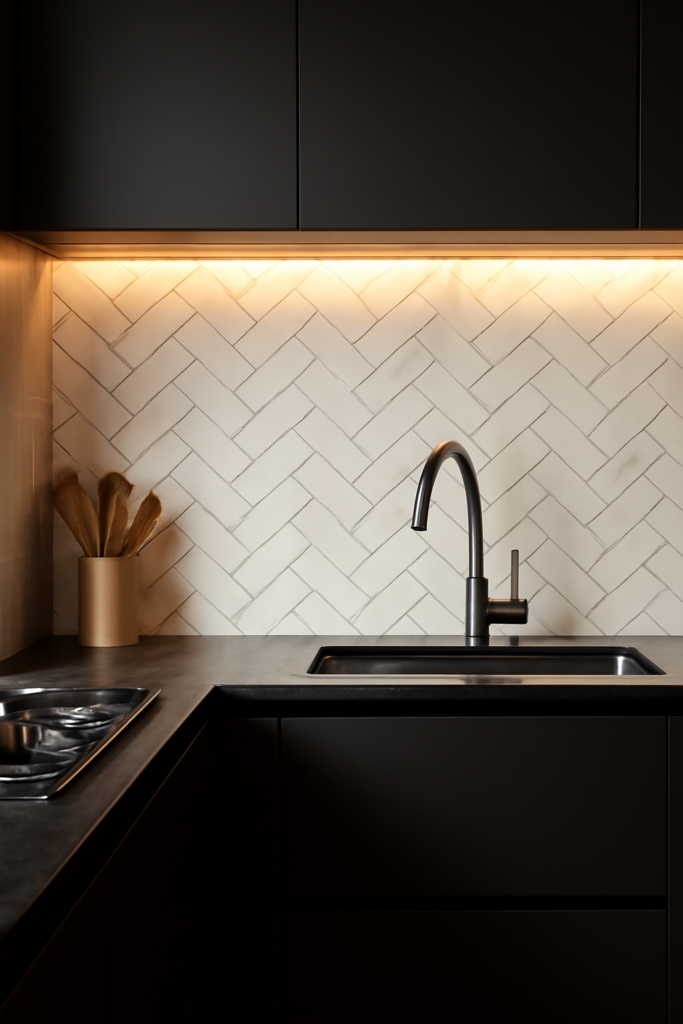
4. Herringbone Subway Tile Pattern

A popular designer favorite because it blends classic tile shapes with high-end geometry.

Benefits:

  • Adds movement and dimension
  • Perfect for creating a “feature wall”

Choose matte white tiles for subtle elegance or colored tiles for a modern edge.


5. Double Herringbone Pattern

A more dramatic version of the standard herringbone, this uses pairs of tiles to create larger V-shapes.

Great for:
Large shower walls & statement kitchen backsplashes.


6. Chevron Layout

Often confused with herringbone, but chevron tiles are cut at an angle to form a seamless zigzag.

Trending in 2025:
Metallic grout paired with matte chevron tiles for ultra-modern luxury.


7. Vertical Herringbone

Creates a tall, arrow-like pattern that expands vertical visual space.

Design benefit:
Perfect for narrow powder rooms and small bathrooms.


8. Basketweave Subway Tile Pattern

This pattern makes tiles appear interwoven, giving a rich, textured aesthetic.

Works best with:
Small-format subway tiles for stronger visual depth.


9. Offset One-Third Layout

A modern twist on the classic running bond, with each tile staggered by one-third instead of half.

Result:
More dynamic, visually interesting lines that feel contemporary.


10. Crosshatch Pattern

Tiles alternate vertically and horizontally, forming a woven grid.

Great for:
Laundry rooms and farmhouse-style kitchens.


11. Diagonal Subway Tile Layout

Standard tiles installed at a 45-degree angle.

Why designers use it:
Diagonal lines make rooms feel wider and more open.


12. Brick Bond With Border

A classic layout with an added border that frames the wall beautifully.

Top 2025 trend:
Borders in contrasting colors (e.g., black border + white center tiles).


13. L-Shaped Corner Pattern

Creates clean transitions around outside corners, especially in showers.

Designer insight:
Helps maintain flow without breaking the visual rhythm.
Subway Tile

14. Mixed Orientation Layout

Combining vertical and horizontal tiles in one installation.

Why it’s powerful:
Adds high-end architectural detail instantly.


15. Gradient Subway Tile Color Layout

Tiles shift from dark to light to create an ombré effect.

Popular color gradients for 2025:

  • Navy → Sky Blue
  • Forest Green → Mint
  • Charcoal → White

16. Two-Tone Subway Tile Layout

Using two colors arranged in a pattern creates a bold, intentional look.

Best usages:
Kitchen feature walls or half-height bathroom walls.


17. Micro Subway Tiles

Tiny rectangular tiles arranged in classic or modern patterns.

Why they’re trending:
They create a mosaic-like texture perfect for luxury spaces.


18. Long Subway Tiles (Oversized Format)

Tiles measuring 4×16 or 3×12 inches give a sleek, elongated appearance.

Benefits:
Makes kitchen backsplashes look more expansive.


19. Dark Grout with White Subway Tiles

This strong contrast highlights tile patterns dramatically.

2025 grout trend:
Charcoal, mocha, and soft graphite tones.


20. White Grout With Colored Subway Tiles

Keeps bold tile colors feeling clean, fresh, and balanced.

Top tile colors this year:
Olive green, midnight blue, terracotta, and matte black.


Best Subway Tile Colors Trending in 2025

1. Deep Greens

Represents biophilic design and nature-inspired spaces.

2. Warm Earth Tones

Especially terracotta and clay hues.

3. Muted Blues

Soft blues paired with white grout create timeless charm.

4. Matte Black

High contrast for modern kitchens and dramatic bathrooms.

5. Creams & Textured Whites

Adds character while maintaining a minimalist feel.


Grout Ideas Designers Are Loving in 2025

✔ Contrast Grout

White tiles + dark grout → bold and modern.

✔ Tonal Grout

Matching grout keeps the look soft and seamless.

✔ Metallic Grout

Gold, bronze & silver grout adds luxury and shimmer.

✔ Warm Neutrals

Beige, taupe & greige for earthy, calm vibes.


Where to Use These Subway Tile Layouts

In Kitchens

  • Backsplashes
  • Feature walls
  • Behind stove areas
  • Around windows

In Bathrooms

  • Shower walls
  • Accent walls
  • Sink backsplashes
  • Niches & inset shelves

FAQs

FAQ 1: What subway tile layout is best for small kitchens?

The best subway tile layout for small kitchens is the vertical stacked or vertical herringbone pattern because both layouts draw the eye upward and make the space feel taller. Using glossy tiles and light-colored grout enhances brightness, which adds even more visual depth and openness to compact kitchens.

FAQ 2: Which grout color works best with subway tile layouts?

The right grout depends on your desired style. Dark grout creates bold contrast, perfect for modern spaces, while light, tonal grout delivers a soft and seamless look. For 2025, warm neutrals like beige, greige, and cream are trending because they balance both contemporary and traditional tile patterns beautifully.

FAQ 3: Are subway tiles still in style in 2025?

Absolutely yes. Subway tiles continue to dominate kitchen and bathroom design because they are affordable, versatile, and available in endless patterns, textures, and colors. Designers in 2025 are experimenting more with layout creativity, oversized formats, textured finishes, and unique color combinations that make subway tiles feel modern and luxurious.

FAQ 4: What tile patterns work best for bathrooms?

Bathrooms benefit from layouts that create height and movement, such as vertical herringbone, classic running bond, or stacked vertical patterns. These designs make compact bathrooms feel larger while maintaining a clean aesthetic. For added texture, consider matte finishes or handmade tiles that catch natural light beautifully.

FAQ 5: How do I choose the right subway tile color?

Start with your home’s overall theme. For modern spaces, go with matte black, navy, or textured whites. For warm interiors, terracotta and green tiles add richness. Always consider lighting—natural and artificial—as it affects how colors appear. Test tile samples in your space before finalizing the design.

FAQ 6: Can subway tiles be used with mixed patterns?

Yes, designers are increasingly mixing patterns like vertical stacking with herringbone or integrating borders with brick bond layouts. Mixed patterns create depth and a custom aesthetic. Just ensure color consistency so the design feels intentional rather than overwhelming.

Small bathroom tile ideas that come in handy

If you don’t have a lot of space but yet want to make a statement, these tiny bathroom tile ideas may help.

Tiles are a must-have in the fight against bathroom spills, and they’re also a great way to add a lot of individuality into even the tiniest of rooms. Fortunately, we have a slew of bathroom ideas under our sleeves to assist you.

Bathrooms at posh hotels and restaurants, which are often designed by well-known designers, are also fertile ground for creative and interesting tiling ideas. Even the tiniest bathroom tile ideas may steal your breath away and make you wish you had one at home.

While there are no bathroom tiles specially made for tiny bathrooms, there are many ways to use tiles to make the most of a limited area. Bathroom trends drive the tile business, so you’ll need to choose wisely to attain distinctiveness. And, more importantly, choose a design that you won’t tire of fast. Click here to read about Remodelling tips for your bathroom tiles.

Bathroom tile ideas for small spaces

Find tiny bathroom tile ideas and professional guidance to aid in the planning of your next project. To assist you in creating an inspirational area, we provide both bathroom wall tile ideas and bathroom floor tile ideas.

1. Create a peaceful environment by using neutral textures.

1. Create a peaceful environment by using neutral textures.

One of the strategies for maximizing space in small bathrooms is to use white bathroom tile designs. However, if you solely utilize white, your space will be lifeless. Instead, use tiles and other materials to provide texture.

‘We wanted to keep the bathroom peaceful and pleasant,’ says Angus Reid of Angus Reid Projects, an interior designer. ‘We utilized a mix of materials, including glossy terrazzo floor bathroom tiles, a clubby French linen blind, a raw wood milking stool, and a really gloomy image of a tumultuous sea,’ says the designer. This variety of textures, together with the soothing color palette, creates an intriguing but attractive environment in which to relax and unwind. ’

2. For tiny bathrooms, choose vibrant floor bathroom tiles.

A monochromatic design is always timeless, but Vipp’s modern fixtures, such as a wall-hung vanity module in powder-coated stainless steel with rubber plated handles, give it a boost. The black floor, which has bathroom tiles by Made a Mano, a fellow Danish design firm, creates a sharp contrast.

3. Create zones with tiny bathroom tile ideas.

Pernille Lind of Pernille Lind Studio says, “We wanted to give this ensuite boldness and individuality, so we built a geometric marble mosaic.” ‘It produces a bold but beautiful impression, with black marble borders that contrast with the light wood flooring in the bedroom area.’

Thassos White, Kavala Grey, and Edessa Black Greek marble are used to create the Tumbled Blocks mosaic tile. It comes on Pernille Lind Studio’s 11 13/16 x 11.13/16 inch (30 x 30cm) net sheets, which are meant to be simple to install.

4. Use a contemporary penny tile.

 Use a contemporary penny tile.

Small bathroom tile designs that are modest are the most effective. Claybrook’s Kasama glazed porcelain mosaic bathroom tiles give architectural interest and subtle modern detail to this room design with their rectangular form and off-white tone. The contrast between the smooth wall painted in deep Caffeine Boost emulsion, also by Claybrook, and the textured appearance is heightened.

5. Use a variety of one-tone tile layouts.

Use a variety of one-tone tile layouts.

These little bathroom tile ideas are a masterclass in getting it right if you’re seeking for shower tile ideas for small areas. This shower has a welcoming effect thanks to the use of various types of bathroom tiles in the same gently neutral color palette to offer intrigue and subtle detail.

On the back wall, natural stone Keystone Cirrus wall tiles are paired with Parramore Fading Field bespoke mosaic, with Keystone Thassos marble mosaic on the floor and ceiling enhancing the cocooning impression. Waterworks is the manufacturer of all of the items.

6. Small bathroom tile ideas that are bold and colorful

In a tiny area, a wet room may be the ideal option; by removing the shower curtain, the whole room becomes visible. Wet room designs, on the other hand, need a lot of tanks, which may quickly lead to tile overload.

Water-resistant polished plaster was color-matched to the emerald green encaustic shower bathroom tiles in this Moroccan-inspired wet room to create a comfortable, cocooning effect.

‘We only utilized the bathroom tiles where they were required to protect the walls and floors from direct touch with water,’ Malcolm adds. Abela Sciberras, Rebirth at Cuschieri Architects, is an interior designer.

7. Play with visual illusions

Taking bathroom floor bathroom tiles up the walls, or in this example up the tub panel, blurs the line between the floor and the walls, giving the impression of more space.

Day True has purposefully mismatched the pattern orientation of the tiles in this bathroom to successfully disguise the point where horizontal meets vertical and make the space look larger.

Make sure the tiles you choose may be used on both the floor and the wall. Some floor bathroom tiles are too heavy to cling to vertical surfaces properly, and wall tiles may fracture when walked on.

8. Consider a completely another form.

When it comes to creating a statement with bathroom tiles, shape may be just as powerful as pattern. Hexagons and fish-scale shaped tiles are still current tile trends, but circular mosaics are a timeless classic that manages to seem on-trend and ageless at the same time.

‘Penny tiles are little and cute, and they give a contemporary take on conventional square mosaics while yet maintaining the luxurious aesthetic that mosaics are known for,’ explains Hamish Smith, Creative Director of Ca’ Pietra.

‘They look excellent in a recess near the tub or shower, but in a tiny bathroom, go floor-to-ceiling with a beautiful accent wall for maximum effect.’

9. Take a different route.

The orientation of the vein pattern in marble bathroom ideas may make a great difference in a tiny space. David Collins Studio used a traditional book-matched pattern for this classy ensuite design.

‘Like a trompe l’oeil,’ adds assistant director Siobhan Kelly, “it makes the area look bigger and is a technique associated with luxury that elevates the marble to a unique piece of art.”

To create diversity and further accentuate the delicate qualities of the natural stone, the mother of pearl mosaics were put around the vanity area. Vertical veining increases the perception of height in a small area, whereas horizontal veining makes a small room appear larger.

If feasible, conduct a dry run by laying out the bathroom tiles to determine the most natural vein connections, then number each one before installation.

Remodeling tips for your bathroom tiles

When it comes to remodeling your bathroom, there are a number of significant choices to make, one of the most enjoyable of which is deciding on the new tile. However, as anybody who has remodeled a bathroom knows, the options are limitless! Is it better to use ceramic or porcelain? Is it better to be classic or abstract? Examining the many sizes, styles, materials, and, of course, prices of bathroom tiles may be entertaining, but it can also be daunting. How can you find the ideal style for your area with so many possibilities on the market?

Here are six pointers to help you choose the perfect bathroom tile.

1. Establish Your Vision

Defining your vision is the first step in selecting bathroom tile. What type of look do you want to achieve? Do you want a relaxing environment to rest in at the end of the day, or do you want to make a bold statement? An excellent place to start is by making a mood/inspiration board. You may then collaborate with your designer and contractor to ensure that the pieces are not only gorgeous but also useful and long-lasting.

2. Make a financial plan

Make a financial plan

Setting a budget is an important part of any home improvement project. Set your bottom line early if you want to be able to comfortably explore your possibilities. Ceramic is often the cheapest option, with porcelain providing a great upgrade because of its longevity. Remember to factor in a 10% breakage allowance, as well as a 15% allowance if you’re installing diagonally or in a space with a lot of curves and angles, since they will need extra cutting and waste.

3. Take into account the tile size

Consider the size of your tile very carefully. Smaller bathroom tiles, such as basketweave or penny tile, are regaining popularity, while bigger bathroom tiles, such as 1224, may give the impression of a greater room. White subway tile is a timeless classic, but try going with a bigger 416 alternative for a contemporary touch.

4. Select Materials

Ceramic that resists stains and odors is a good and affordable option, but porcelain is a better choice because of its water resistance and comprehensive body composition (blue tile is blue all the way through, not just on the surface like with ceramic). Glass, marble, and other natural stones should not be ruled out. Glass is always light and striking, but it may be difficult to install, so be sure your contractor is up to the task! Marble is gorgeous and ageless, but it is scratch-prone and requires frequent sealing.

5. Playing with Patterns

 Playing with Patterns

Choosing an abstract pattern tile to create a show-stopping impression in a tiny room can be a lot of fun. Aside from pattern-based bathroom tiles, others are being created to produce patterns by the way they are mounted on walls and floors. The ever-popular hexagon tile may be seen throughout design history, and contemporary diamond Escher bathroom tiles (shown above) are particularly trendy.

6. Don’t Forget About the Grouting

A good grout job may make or break your tile work, so don’t skimp on this crucial phase. The color of your grout might be just as essential as the tile you choose. Visit http://www.larsadditions.com/ for more information. Do you want to match the grout to the tile or choose a different color to make your tile stand out? White grout is always traditional, but it’s more difficult to maintain clean and may need more upkeep. If you choose a contrasting grout color, make sure the contractor protects your glazing with a sealer or grout release. Grout now comes in a variety of colors, including gray, beige, black, and even rose or light green! Choosing a medium that your contractor is comfortable dealing with is also important – some like premixed grout, while others prefer to create their own.

Keep in mind the upkeep.

Sure, some of the bathroom tiles you’ve picked are really pleasing to the eye. Yes, it has all of the aesthetic qualities you want, but cleaning and maintaining it will be a significant chore. If you don’t want to be burdened with a time-consuming cleaning duty, this may not be the best option.

It is suggested that porcelain or ceramic bathroom tiles be used in bathrooms. They’re not just ideal for high-moisture environments, but they’re also simple to keep clean. Natural stone bathroom tiles, on the other hand, need a little more attention. They’re prone to attracting dirt and filth, particularly if they’re often wet.

Create a sense of spaciousness.

Create a sense of spaciousness.

Bathrooms, as you may be aware, are rather tiny. To compensate for this, you may use a few smart tricks to make it look bigger than it is. Here are some strategies you may use:

Bathroom tiles with a diagonal pattern.

In a small bathroom, diagonal tiles are fantastic. Diagonals deceive the sight into assuming that a room is much bigger than it really is. For starters, determining the number of those diagonal bathroom tiles will be tough, making them seem to be many. It’s this apparently endless nature that contributes to the expansive atmosphere they create in a space.

Colors that are light.

Light hues expand the space and give it an airy atmosphere. However, don’t restrict yourself to white floor tiles. Other hues, as long as they’re portrayed in a lighter shade, are likewise acceptable. You can read about Small bathroom tile ideas that come in handy by visiting http://homestar-finch-recall.com/small-bathroom-tile-ideas-that-come-in-handy/

Tiles that are large.

Because smaller bathroom tiles have more grout lines, the floor seems grid-like and boxed up. Large bathroom tiles, on the other hand, have fewer grout lines, which allows for more room. They open up a space and make it seem less claustrophobic.

The Most Important Takeaway

Your bathrooms may be little in comparison to the rest of your house, but that doesn’t mean they don’t need the same level of care.

In fact, their modest size necessitates extra caution while picking floor bathroom tiles. That’s only one of a slew of other considerations. Because floor tiles can completely transform the appearance of a space, it’s critical that you choose the right ones for your bathroom.

When choosing bathroom tiles, feel free to go back to these guidelines. The suggestions in this article might assist you in avoiding expensive errors. 

2022 Hottest Trends with Herringbone Tiles

Home interior designs have had some hot trends in the year already, with the return of the herringbone pattern. One of the most unique features of the herringbone tiles is blending with vintage exquisiteness and modern design concepts. The result is usually a captivating look within the home, either for the kitchen or the bathroom. 

The shape that the herringbone tiles show is derived from the herring fish bones. These tiles are also swirling marble, wood, porcelain, or wood. In these materials, a stunning surrounding can be built. It works for the wall and can also work for the walls and retain its beauty for years to come. 

Uses of the Herringbone Pattern

The versatility of the herringbone design means that it can work suitably for not only the floor but also the walls as well. Therefore, one needs to care for the kinds of tiles you choose and the materials they are made from. In other words, the applications of herringbone tiles largely depend on the type of tile you select. And most excellent interior designers have captured this fact. 

Therefore, they do not limit their chances to the wooden material but also those made of porcelain and marble. While herringbone tiles could mimic rigid material, it is much more usable and durable for a long time to come. It can also work for places in the home that are often moist and wet such as the bathroom and the kitchen. So, when buying herringbone tiles, ensure to check the rating before you install them on your floor or walls. 

Other factors in determining your election include the color scheme and the pattern design, if not plain. When you apply herringbone tiles to your kitchen for an upgrade, you should not forget to balance things up. For example, the choice of subway tiles and glass tiles should produce a beautiful touch and have an accessible cleanup property. 

Trendy Tips and Ideas for Herringbone Pattern

The first step to laying herringbone tiles successfully, like any other project, is adequate planning alone with precise and accurate measurements. First, it does not matter whether you apply them to the wall or the floor. Meanwhile, you may also want to draft out the pattern to use in advance, choosing between the 90-degree and 45-degree variants. Each of these variants comes in its own classic design of what people consider on the two sides.

While the 90-degree variant is more rigid and geometric, the diagonal pattern brings a timeless approach and feel. The latter also adds a luxury touch to the room. However, the rugged look of 90-degree designs is also a good option if we need the modern aesthetic value it brings. On the other hand, diagonal options give a more elegant look each time. 

When laying herringbone tiles for the floor, you may need to consider the porcelain material, which looks more like wood. This material and the finish can give your home the kind of warmth you may be dreaming of. At this point, you may begin to wonder if this method is also advisable for the sake of maintenance. But you have no need to worry in that regard. This ease of maintenance is also expected from a typical hardwood flooring.

Tips and Ideas for Herringbone Pattern

Contrary to older styles, the herringbone does not have to be in a single, monochrome color. However, you should consider installing several tones within the same spectrum. For instance, you may set a tone with gray or blue and consider spicing things up with their shades, respectively. 

The style is also capable of a level of visual depth that can lift the assortment of color in any surrounding. Meanwhile, any choice of single or multiple colors goes well for herringbone tiles. So, feel free to try out a few combinations while you check to see which one is perfect for what you dream. Now, let us look at some of the critical tools you may need for installing them. 

Needed Tools to Install Herringbone Tiles

Below are some of the essential tools that anyone needs to put in place to install herringbone tiles. Alongside are also that can help you have a perfect installation process. 

Mortar

The mortar is the mixture you can get from many home improvement stores. This material can then be mixed with water when it is time to use it. Also, you can be sure that the correct mortar type is strictly a function of the kind of needs. Then, mix it thoroughly to ensure that you now have a homogenous and smooth mixture. As you go in the process, you will be applying these mortar in small sections. 

Trowel

The trowel is a small handy tool that you can use both to mix and apply the mortar on the floors and walls while laying the herringbone tiles. You can also use the trowel to spread the mortar in the process or scoop mortar from the bucket onto the surface. When applying the mortar with the trowel, you should slowly apply it with a tooth side down as slowly as possible. You can also use it in a gentle sweeping motion. The trowel size is dependent on how big your project is, the thickness of the mortar. 

Spacers

Spacers are pieces you use to create small spaces between individual tiles for gaps. The amount of space you need to make between tiles depends on the initial measurements of the room and the size of herringbone tiles in use. 

Wet Tile Saw

The wet tile saw is available to cut and trim your tiles as the job goes on. However, before cutting, ensure you wear a pair of glasses to protect the eyes. Remember to use gloves while you do the cutting gently and more assuredly. You can be sure of where to cut by first marking the lines on the tiles. 

Grout and grout float

Another essential material for laying herringbone tiles is the grout and the float. The mixing process of the grout mixture depends on the instructions that the grout manufacturer provides. You can also apply the grout to all the spaces and fix the tiles using a rubber grout float. After the laying process, wipe off the cloudiness and dirt using a soft and damp cloth and let it dry before walking on the tiles. Also checkout guide the use of the herringbone tiles pattern.